
close
Choose Your Site
Global
Social Media
Views: 0 Author: Site Editor Publish Time: 2026-08-21 Origin: Site


Textile manufacturers constantly face a complex sourcing dilemma. Selecting the wrong textured yarn easily leads to high defect rates. You might experience a compromised fabric feel or face costly production delays. Both Air Textured Yarn (ATY) and Draw Textured Yarn (DTY) serve as fundamental building blocks in modern textile production. However, their distinct texturing processes yield fabrics exhibiting fundamentally different performance characteristics and aesthetic finishes. These structural differences dictate how the final product performs under physical stress. This guide provides a strictly comparative, evidence-based framework. You will learn how to choose between ATY and DTY based on technical requirements, cost profiles, and scalability. We help procurement managers and production engineers confidently source the right materials. Understanding these core variations ensures your production lines run smoothly.
Understanding the manufacturing process helps you predict yarn behavior. Producers use distinct mechanical approaches to transform raw continuous filaments into usable textile yarns. These differences directly influence the final fabric texture.
The DTY process relies on thermal manipulation. Manufacturers feed Partially Oriented Yarn (POY) into a false-twist texturing machine. The machine draws and twists the yarn simultaneously under high heat. Spindles or friction discs rotate at extreme speeds to introduce mechanical twist. The yarn then passes through a heater plate. This plate usually operates between 180°C and 220°C.
Heat permanently sets the molecular structure of the polyester. Once the yarn cools and untwists, it retains a memory of that twisted shape. This creates thermo-set crimps. These crimps provide the yarn with inherent elasticity and significant volume. The resulting material stretches easily and recovers quickly. It traps air efficiently to provide insulation.
Air texturing takes a purely mechanical approach. It does not rely on heat setting to create texture. Instead, producers overfeed POY or Fully Drawn Yarn (FDY) through an advanced air jet nozzle. Inside this specialized chamber, high-pressure compressed air attacks the filament bundle. The turbulent airflow disrupts the straight filaments.
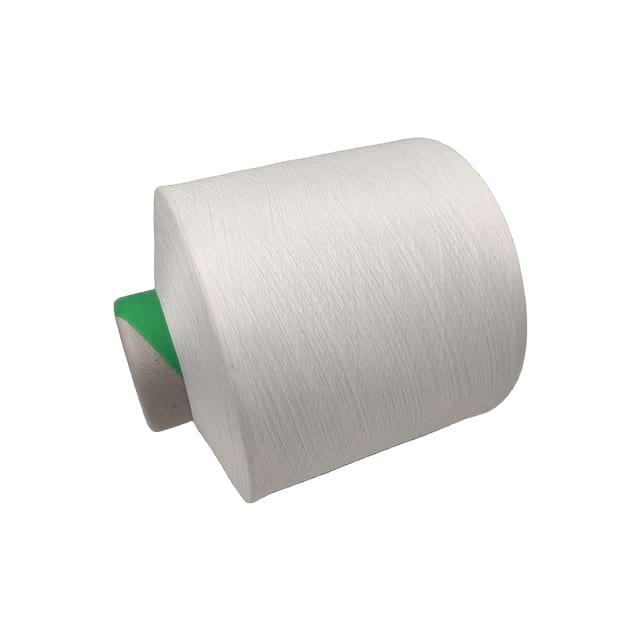
This process creates millions of microscopic interlaced loops. The continuous filaments entangle around each other tightly. The outcome is a highly bulky structure. It mechanically locks the filaments in place. Because the loops do not behave like thermal springs, the yarn remains entirely non-stretch. This advanced method perfectly simulates natural staple fibers. Polyester ATY Yarn delivers immense bulk without the typical elasticity found in heat-treated yarns.
Engineers must match yarn properties to product specifications. You cannot interchange these yarns without radically altering the fabric. We evaluate them across three primary physical dimensions.
Surface texture dictates consumer perception. DTY tends to have a softer hand-feel. It retains a slightly synthetic slickness. The visual luster ranges from semi-dull to intensely bright. Light reflects linearly off the uniform crimps. This gives DTY fabrics a subtle, sporty sheen.
In contrast, Polyester ATY Yarn delivers a distinctively dry finish. The surface feels deeply matte. The entangled loops scatter light in multiple directions, eliminating synthetic sheen. It closely replicates the tactile experience of spun cotton or wool. This "spun-like" hand-feel elevates synthetic garments into premium casualwear categories.
Garment shape retention relies entirely on yarn elasticity. DTY features excellent stretch characteristics. The zig-zag crimps act like microscopic springs. When pulled, they straighten out. When released, they snap back. This makes DTY ideal for form-fitting apparel.
ATY behaves differently. It is inherently rigid. The compressed air process locks the loops securely. Pulling the yarn simply tightens the existing mechanical knots. It offers zero stretch. However, this rigidity grants superior dimensional stability. Fabrics woven from this yarn refuse to sag, bag, or stretch out of shape over time.
Abrasion tests reveal stark contrasts in fabric longevity. Loose-crimp DTY sometimes struggles with snagging. Sharp objects can catch the open crimps, pulling filaments loose. Over time, friction causes these loose fibers to pill.
ATY demonstrates remarkable abrasion resistance. The loop-locked surface creates a dense armor. Filaments cannot easily pull free from the central core. This mechanical entanglement vastly reduces snagging vulnerabilities. It outperforms standard textured yarns in heavy friction environments.
Product developers must align material science with commercial goals. Choosing the wrong yarn leads to catastrophic product failures. Let us look at specific industry applications.
You should specify DTY when flexibility is paramount. The activewear industry relies heavily on this material. DTY accommodates rigorous body movements without restricting the wearer.
Consider these target applications:
The success criteria for these products include high stretch requirements and lightweight warmth. DTY filaments also integrate well with moisture-wicking chemical treatments. They pull sweat away from the skin efficiently.
You should specify ATY when you need structural integrity. It dominates sectors requiring extreme durability alongside a premium, natural look. It replaces expensive natural fibers while maintaining synthetic strength.
Consider these target applications:
The success criteria here focus on longevity. You need a natural-fiber aesthetic combined with pure synthetic durability. Polyester ATY Yarn provides high tear strength. Its zero-stretch profile ensures automotive seats and luggage panels hold their precise dimensions indefinitely.
Procurement teams evaluate more than just aesthetic appeal. Production speeds and machinery adjustments heavily influence your final unit costs. We must address these operational realities.
Production efficiency drives profitability. DTY output is notoriously fast. Modern false-twist machines run at incredibly high speeds. This high-speed output efficiency keeps unit costs exceptionally low. The thermal process scales beautifully for massive commodity orders.
ATY presents a different production profile. The air texturing process runs slower. The turbulence chambers require immense volumes of compressed air. Generating this compressed air is energy-intensive. Consequently, ATY carries a higher initial premium. However, smart brands offset this cost. You can eliminate the need to blend expensive natural cotton into specific fabric lines. A pure synthetic woven fabric mimics cotton perfectly, streamlining your supply chain.
Production Speed and Efficiency Chart
| Production Metric | Draw Textured Yarn (DTY) | Air Textured Yarn (ATY) |
|---|---|---|
| Average Production Speed | 600 to 1200 meters per minute | 300 to 600 meters per minute |
| Energy Consumption Source | Thermal heaters (Electricity) | Air compressors (High electricity demand) |
| Unit Cost Profile | Low to Moderate | Moderate to High |
| Blending Requirement | Often blended with Spandex | Rarely requires natural fiber blending |
Switching yarn types disrupts the factory floor. You cannot thread a loom identically for both materials. Tension control requires immediate attention. Looms configured for high-stretch DTY operate with specific tension parameters. If you feed rigid ATY into that same setup, yarn breakages spike. Mechanics must adjust feeding tensions to accommodate the rigid structure.
Dye uptake also demands close observation. The physical structure of loops versus crimps drastically alters dye penetration. Heat-set DTY absorbs dye differently than mechanically locked ATY. The dense loop structure can sometimes resist initial dye penetration. You must conduct extensive baseline testing. Always run pilot dye batches before scaling to bulk production.
Sourcing raw materials introduces significant risk. A single bad batch can ruin an entire production run. Procurement teams must deploy rigorous vetting protocols.
You must verify supplier capabilities through documentation. Never rely on verbal assurances. Ask technical questions to assess their manufacturing competence.
First, request technical data sheets. For ATY, demand data detailing "loop stability." If loops pull out under minor tension, the yarn will fail in weaving. For DTY, request data on "crimp rigidity." Inconsistent crimps cause garments to pucker unevenly after washing.
Watch for specific red flags in procurement:
Establish strict inspection routines upon delivery. Factory floors must reject defective cones immediately.
Quality Inspection Checklist Table
| Inspection Area | Defect to Watch For | Impact on Production |
|---|---|---|
| Visual Surface Check | Broken filaments (Snowing effect) | Creates dust buildup in looms, causing breaks. |
| Cone Density | Soft or unevenly wound edges | Causes erratic unwinding tension during knitting. |
| Dye Affinity | Batch-to-batch color variation | Leads to severe banding and striping in finished fabrics. |
| Physical Pull Test | Loops pulling straight (ATY only) | Results in localized loss of bulk and texture in garments. |
Visual inspection is paramount. Look for broken filaments on the cone surface. In ATY, severe breakage causes a "snowing effect." Micro-filaments shed into the air during weaving, clogging loom mechanisms. Furthermore, you must aggressively test colorfastness. Run lab dips to verify batch-to-batch dye uniformity before authorizing bulk fabric knitting.
Your sourcing choices dictate your product's market success. The differences between these materials are structural, functional, and financial. Navigating this landscape requires careful planning and robust testing.
A: Yes, textile engineers frequently weave them together. Factories often use DTY for the warp to provide subtle stretch, while utilizing ATY for the weft. This specific combination effectively balances production costs, garment elasticity, and a premium natural hand-feel.
A: No. ATY generally exhibits lower shrinkage rates during high-heat dye processes. DTY's thermal memory can cause its crimps to contract slightly under intense heat. ATY relies on a mechanical loop lock rather than thermal memory, granting it superior thermal stability and tighter standard shrinkage tolerances.
A: Both yarns are available in recycled variants (rPET) derived from plastic bottles. The true sustainability metric relies heavily on the supplier's primary energy source and raw material management. The texturing process itself matters less than how the factory sources its electricity and handles water waste.
